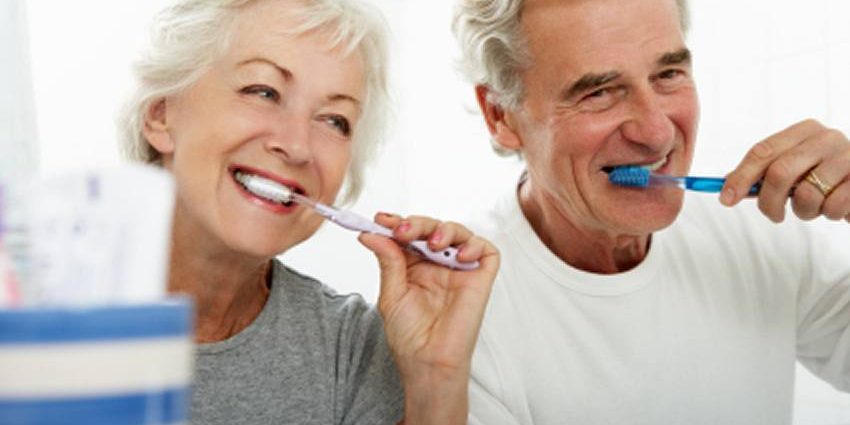
As we know, many dependent seniors wear dentures. What are dentures? A denture is an artificial material that mimics teeth and gums as a replacement (What are dentures?, 2019).
Dentures are considered to restore oral functions (including missing teeth and bone resorption) and to restore the facial features around the mouth (Darby, & Walsh, 2014, p.1006).
There are different types of dentures made in a laboratory to meet the needs of individual seniors as listed below:
- Partial denture -> replaces only some and not all missing teeth and gums. Can be removed and placed back into the mouth by the client. The partial denture rests on metal framework (retainer clasps) and is supported by natural teeth when placed inside the mouth (Darby, & Walsh, 2014, p. 1007).
- Full/complete denture -> replaces all teeth and gums of either the upper or lower arch. Can be removed and placed back into the mouth by the client (Darby, & Walsh, 2014, p. 1008).
Caring for the denture includes removing the denture to clean after eating and before bed. Brushing the denture with a cleaning solution and a denture brush daily will avoid microorganisms from harvesting on to the denture and remaining inside the oral cavity. Soaking the dentures before bed time in water with a mild overnight cleanser will remove the bacteria (which also removes the odour) and the moisture will stabilize the shape of the denture. (Proper Denture Care and Maintenance, 2019)
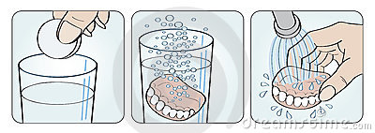
(Dental Use and Care Instructions, n.d.)
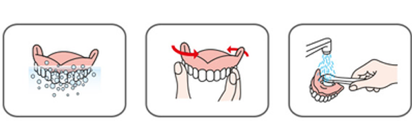
(Dental Use and Care Instructions, n.d.)
The advantages for dependent seniors with dentures are the following:
- Seniors will have a full functioning set of teeth to assist with smiling, speaking and chewing solid foods (What are the benefits of dentures?, n.d.)
- Have them look and feel much better about their overall appearance (without the ‘sunken cheek’ appearance) (What are the benefits of dentures?, n.d.)
- Can last for a long time only if taken care properly – around 5-10 years (Dentures: Their Advantages and Disadvantages, 2019)
Although dentures can be a huge advantage to many, there are many disadvantages to consider, as listed below:
- Dentures tend to move around in the mouth, which can become irritable when chewing or speaking (will need some getting used too) (What are the benefits of dentures?, n.d.)
- Denture care needs to be addressed as important as caring for natural teeth to avoid any bacteria build up (What are the benefits of dentures?, n.d.)
- Masticatory stress (pressure in the mouth from the denture) can result in continuing alterations to the gums and oral cavity (Darby, & Walsh, 2014, p. 1010).
- There are risks of having inflammation and lesions in the mouth, if not removed and cleaned properly (Darby, & Walsh, 2014, p. 1010).
- Bacteria left on denture built up can cause periodontal disease – first signs being tartar at the base of the teeth, which then lead to tissues of the teeth and gums being destroyed (Oral Care for the Elderly, n.d.)
Dependent seniors may not be caring for their dentures as often or adequately as they should be and that can be due to many reasons; such as the family member or caregiver is unable to care for the senior adequately and/or regular dental visits for them decrease or cease over time (Our health system neglects the oral health of dependent seniors with tragic consequences, 2017).
When caregivers and/or family members are providing the care for others, it requires a skill with the responsibility and resources to do the care regularly and properly (Our health system neglects the oral health of dependent seniors with tragic consequences, 2017). While the registered nurses of Ontario have a guideline called “Oral Health Nursing Best Practice Guidelines” that they follow to ensure proper daily oral care is being performed for the dependent seniors, it is important that the seniors and family members understand the importance and are as well educated on the concerns (Our health system neglects the oral health of dependent seniors with tragic consequences, 2017).
The following listed below must be taken into consideration for the caregiver and family member in order to avoid any problems in oral cavity of the dependent senior:
- Dental visits regularly (Caring for Dentures tips for Seniors and Caregivers, n.d.)
- Encouraging the seniors to remove and clean on their own with support if needed (Caring for Dentures tips for Seniors and Caregivers, n.d.)
- Avoid cross-contamination by wearing gloves (Caring for Dentures tips for Seniors and Caregivers, n.d.)
- First remove the lower by holding the front teeth between the thumb and index finger and then lifting it out. Next remove the upper denture by lifting the lip and using fingers to tip the front teeth (rocking the denture back and forth may help remove the seal) (Caring for Dentures tips for Seniors and Caregivers, n.d.)
- Carefully remove partial dentures by using fingers and gently pulling the metal clasps away from the teeth (either downward or upward motion) (Caring for Dentures tips for Seniors and Caregivers, n.d.)
- Remember to inspect the mouth for any sore spots that do not heal in a few days, white or red patches, or any changes of colour in the mouth. These concerns may need to be addressed to a dentist (Tips for Caregivers, 2019).
- Assist with proper denture cleaning performed as listed before and clean any natural teeth if any are remaining (Caring for Dentures tips for Seniors and Caregivers, n.d.)
- Clean by massaging the inside of seniors’ mouth using a damp cloth or a soft toothbrush (Tips for Caregivers, 2019)
- Encourage the senior to reinsert the denture or assist if help is needed (Caring for Dentures tips for Seniors and Caregivers, n.d.)
By doing these important necessary steps, this will reduce the risks of any concerns, the seniors will feel more confident and will keep smiling!
JE
References
Caring for Dentures tips for Seniors and Caregivers. (n.d.). Retrieved from Your dental health: http://www.yourdentalhealth.ca/Assets/Caring%20for%20Dentures_YDH.pdf
Darby, & Walsh (2014). Dental Hygiene: Theory and Practice 4th Edition. St. Louis: Elsevier Canada
Dental Care Tips for Seniors. (n.d.). Retrieved from Smile of Bellevue: https://www.smilesofbellevue.com/2016/01/20/dental-care-tips-for-seniors/
Dental Use and Care Instructions. (n.d.). Retrieved from Ivory Dental Clinic: http://ivorydentalclinic.co.in/patient-info/post-treatment-info/denture-use-and-care-instructions/
Dentures: Their Advantages and Disadvantages. (2019). Retrieved from Really Smile: https://www.reallysmile.com/blog/dentures-their-advantages-and-disadvantages/
Oral Care for the Elderly. (n.d.). Retrieved from Nha Khoa Nhan Tam Dental Clinic: https://www.nhakhoanhantam.com/blogs/oral-care-for-dependent-elderly/oral-health-care-for-the-elderly
Our health system neglects the oral health of dependent seniors with tragic consequences. (2017, July). Retrieved from Ottawalife: http://www.ottawalife.com/article/our-health-system-neglects-the-oral-health-of-dependent-seniors-with-tragic-consequences
Proper Denture Care and Maintenance. (2019). Retrieved from Millwoods Denture Clinic: https://www.millwoodsdentureclinic.com/b/proper-denture-care-and-maintenance
Tips for Caregivers. (2019). Retrieved from Canadian Dental Association: https://www.cda-adc.ca/en/oral_health/cfyt/dental_care_seniors/tips.asp
Types of Prosthodontic Prostheses. (2014). In &. W. Darby, Dental hygiene: theory and practice 4th edition (p. 1007).
What are dentures? (2019). Retrieved from Colgate: https://www.colgate.com/en-us/oral-health/cosmetic-dentistry/dentures/what-are-dentures
What are the benefits of dentures? (n.d.). Retrieved from Medic8: http://www.medic8.com/cosmetic-dentistry/dentures/benefits-dentures.html

 Bringing Life to Your Smile
Hi Jen,
I’m so glad you chose to write about this topic! Before taking dental hygiene, denture care was never something I had thought about. I didn’t realize that so many seniors struggle with denture care wether on their own or in result to family/care giver. I feel it is very helpful to have key points for family and/or caregivers to care for the dependent senior’s oral health.
Dental Hygiene Canada wrote an article discussing seniors oral health. A point they made I found stood out to me was that even after you lose your teeth, there is still food and bacteria accumulating in your mouth (Dental Hygiene Canada, n.d.). I feel like a lot of seniors feel that once they don’t have their natural teeth anymore, there is no need to pay any attention to their oral cavity.
Hopefully, by having more conversations, we can bring awareness to the oral health of seniors. Even with younger patients, being able to open the discussion may help them relate and make changes for a senior in their life!
Dental Hygiene Canada. (n.d.). Seniors’ Oral Health. Retrieved from Dental Hygiene Canada: https://www.dentalhygienecanada.ca/DHCanada/Seniors/Denture_and_Mouth_Care/DHCanada/Seniors/seniorsOralHealth.aspx
– Ali Crampton
LikeLike
Hi Ali!
Thanks for the response! I agree, before taking dental hygiene, I did not know that this was one of the big issues and concerns with seniors and how they care for their oral hygiene.
I can very much agree with your fact about seniors not knowing the importance of caring for their gums as much as it is importance for caring for their teeth (Dental Hygiene Canada, n.d.). This is definitely something they themselves and their family/caregivers could be more educated on.
Great point!
Reference:
Dental Hygiene Canada. (n.d.). Seniors’ Oral Health. Retrieved from Dental Hygiene Canada: https://www.dentalhygienecanada.ca/DHCanada/Seniors/Denture_and_Mouth_Care/DHCanada/Seniors/seniorsOralHealth.aspx
LikeLike
Hi Jen,
I think your post gives a great overview of denture considerations relevant to dependent seniors and their caregivers! I definitely agree that this population is at increased risk for poor denture maintenance because caregivers may be unmotivated or unable to provide effective assistance. For instance, if a dependent senior suffered from multiple systemic health conditions, management of potentially life-threatening diseases might be prioritized over denture care. As a result, it is important for us as Dental Hygienists to educate caregivers about the implications of allowing biofilms to accumulate on oral prostheses. A example is oral candidiasis because many characteristics of dentures, such as surface permeability and enhanced biofilm retention, are conducive to Candida albicans proliferation (Gleiznys, Zdanaviciene, & Zilinskas, 2015, p. 58). The literature review cited below discusses risk factors, preventive strategies, and treatments for candida albicans infections in clients with dentures.
Thank-you for sharing this information!
Lisa-Abigail
Reference
Gleiznys, A., Zdanaviciene, E., & Zilinskas, J. (2015). Candida albicans importance to denture wearers. A literature reivew. Baltic Dental and Maxillofacial Journal, 17, 54-66. Retrieved from http://www.sbdmj.com/152/152-04.pdf
LikeLike